

Building an Inclusive AI Future: Key Takeaways from the EQUALS Dialogues at the AI for Good Global Summit 2026

As artificial intelligence reshapes economies, workplaces and entrepreneurship around the world, one question is becoming increasingly urgent: who will benefit from the AI revolution, and who risks being left behind?

At the AI for Good Global Summit 2026, EQUALS convened two high-level dialogues to explore this challenge from complementary perspectives. Bringing together leaders from international organizations, governments, the private sector and civil society, the sessions focused on ensuring that women are not only prepared for the AI economy, but are actively shaping it.
Together, the discussions highlighted a common message: achieving gender equality in the AI era requires more than expanding access to technology. It demands coordinated action to remove structural barriers, strengthen skills, foster inclusive innovation ecosystems, and ensure women have opportunities to lead in the design, development and governance of AI.
Dialogue One: AI, Trade and Inclusive Digital Business

The first EQUALS Dialogue explored how AI is transforming entrepreneurship, digital business and international trade, with a particular focus on women-led enterprises.
The session was opened by Sylvia Poll, Senior Gender and Youth Advisor to the Secretary-General at the International Telecommunication Union (ITU), who framed the discussion around the need to ensure that AI-driven innovation creates opportunities for everyone. She noted that while AI has enormous potential to unlock new markets and business opportunities, deliberate action is needed to ensure women entrepreneurs are able to participate fully in and benefit from the digital economy.
Looking toward 2030
The opening fireside conversation featured Jayathma Wickramanayake, Senior Policy Advisor at UN Women and former United Nations Secretary-General's Envoy on Youth, and Ghalya Al Mannaee, Chairwoman of Strategic Affairs and Development at the UAE General Women's Union. Together, they reflected on what success should look like for women entrepreneurs in the AI economy by 2030. Their discussion emphasized that women should not simply adapt to AI-driven markets but play an active role in shaping them. They highlighted the importance of building confidence, digital skills and supportive policy environments that enable women to innovate, compete and lead in digital trade and emerging AI industries.
AI is already transforming women-led businesses

The second half of the session transitioned to practical experiences from the field and was moderated by Natalya Kozlenkova, Programme Officer in the Sector and Enterprise Competitiveness Section at the International Trade Centre (ITC). Joining the discussion were Sara Andersson, Technical Officer for Women's Entrepreneurship Development at the International Labour Organization (ILO), and Abigail C. Gooch, Global Corporate Responsibility Innovation and Engagement Leader at EY. Drawing on their respective expertise, they explored how women entrepreneurs are already using AI to improve business operations, reach new customers, increase productivity and drive innovation.
The discussion explored a growing range of AI applications—from improving productivity and customer engagement to streamlining business operations, accessing new markets and supporting innovation. These examples demonstrated that AI has the potential to lower barriers for small and medium-sized enterprises while creating new opportunities for growth.
However, participants also acknowledged that access to these opportunities remains uneven.
Several persistent challenges emerged throughout the dialogue, including:
Limited access to AI skills and digital literacy training.
Financing gaps that constrain technology adoption.
Unequal access to business networks and mentorship.
Limited awareness of available AI tools and practical use cases.
The need for trustworthy, safe and inclusive AI systems that respond to women's business needs.
Speakers stressed that addressing these challenges requires collaboration across governments, international organizations, industry and the entrepreneurial ecosystem. Multi-stakeholder partnerships such as EQUALS were highlighted as valuable platforms for connecting expertise, sharing good practices and supporting women-led digital businesses worldwide.
The discussion concluded with a shared recognition that AI should become an engine of inclusive economic growth—not another source of inequality.
Dialogue Two: Skills, Careers and Inclusive AI Futures
The second EQUALS Dialogue shifted the focus from entrepreneurship to the future of work, examining how AI is reshaping jobs, career pathways and leadership opportunities for women.
The discussion opened with remarks from Maud Aba'a of ITU, who invited participants to consider whether today's AI transition is creating genuinely inclusive opportunities or reinforcing existing labour market inequalities.
Reading the signals of the AI transition

The opening fireside discussion brought together Glenda Quintini, Head of the Skills and Future Readiness Division at the OECD, Sarah Steinberg, Global Affairs & Policy Strategy Leader at LinkedIn, and Daniella Darlington, CEO and Co-founder of Alleina AI and member of the ITU Secretary-General's Youth Advisory Board.
Drawing on labour market evidence, policy insights and entrepreneurial experience, the panel examined how AI is transforming the workforce. Speakers discussed how women remain disproportionately represented in occupations most exposed to AI-driven automation while continuing to be underrepresented in many of the fastest-growing AI careers. They also explored the growing disconnect between rising demand for AI skills and unequal access to quality employment, career progression and leadership opportunities.
Closing the gap between skills and opportunity
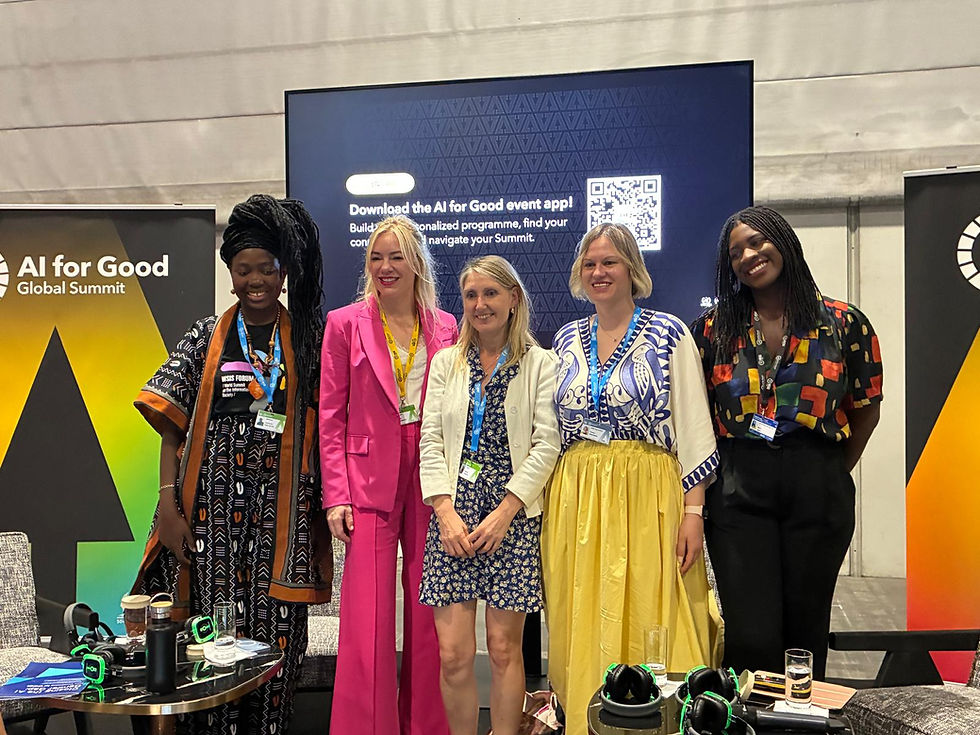
The interactive dialogue that followed was moderated by Tamara Dancheva, Programme Lead for Special Initiatives at GSMA. Building on the earlier discussion, participants explored where the AI transition is leaving women behind and what systemic changes are needed to close the gap between skills and opportunity.
Rather than framing the challenge solely as a skills issue, the discussion highlighted broader structural barriers, including recruitment practices, workplace culture, career progression pathways and representation in leadership and decision-making. Speakers emphasized that preparing women for AI careers must go hand in hand with creating workplaces and institutions where they can advance, influence decision-making and lead innovation.
In her closing reflections, Tamara Dancheva reinforced the importance of collaboration across governments, industry, academia and international organizations. She highlighted EQUALS as a unique global partnership capable of bringing these communities together to support more inclusive AI skills development, career advancement and leadership opportunities for women.
Shared Themes Across Both Dialogues
Although the two sessions focused on different aspects of the AI economy, several common messages emerged.
Inclusion must be designed into AI from the beginning. Gender equality cannot be treated as an afterthought. Policies, technologies and innovation ecosystems need to be intentionally designed to ensure women can participate fully in shaping AI.
Skills alone are not enough. Expanding AI education remains essential, but participants stressed that training must be accompanied by equal access to financing, employment opportunities, entrepreneurship support, leadership pathways and decision-making roles.
Partnerships are critical. Governments, international organizations, academia, industry and civil society each have an important role to play in building inclusive AI ecosystems. Collaboration across sectors will be essential to scale successful approaches and address systemic barriers.
Women must be recognised as creators, innovators and leaders. Across both discussions, speakers emphasized moving beyond narratives that position women solely as beneficiaries of AI. Instead, women should be supported as entrepreneurs, researchers, policymakers and business leaders who help define the future of AI.
Looking Ahead
Together, the two EQUALS Dialogues reinforced the importance of placing gender equality at the centre of the global AI agenda.
As AI continues to transform business, trade, labour markets and society, ensuring that women can access opportunities, influence decision-making and lead innovation will be essential for building inclusive digital futures.
By convening diverse voices and fostering collaboration across sectors, EQUALS continues to strengthen global efforts to ensure that the AI economy benefits everyone—and that women are empowered not only to participate in the AI transition, but to shape it.


